
Data Governance requires only the basic business tools to achieve its objectives. Data governance is a process of ensuring controls over data exist to achieve the most value from data assets.
Variations of Data Governance definition are as follows;
Data Governance (DG) is defined as the exercise of authority and control (planning, monitoring, and enforcement) over the management of data assets. – DAMA-DMBOK2
Data Governance is the formal execution and enforcement of authority over the management of data and data-related assets. – Robert S. Seiner (Non-Invasive Data Governance)
Data Governance is the organization and implementation of policies, procedures, structure, roles, and responsibilities which outline and enforce rules of engagement, decision rights, and accountabilities for the effective management of information assets. – John Ladley (2020) – Data Governance 2nd Edition
All three definitions cited above agree on “enforcement” of authority or rules over “management of asset (data)”. Therefore, in order to achieve Data Governance in an organisation, we need policies (rules that apply to data), enforcement of those policies, and the monitoring of the application of the policies to ensure the business achieves its intended values and objectives from its data.
In order to achieve this goal, Data Governance requires engagement with Business decision makers, Business domain experts, Change Management and Legal teams. Periodic engagement and regular reporting to these stakeholders is essential. Therefore a tool which allows easy reporting on the status of compliance with governance policies is key. If the business has existing tools, these can be adapted. A process workflow is also required which introduces checkpoints along the data lifecycle.
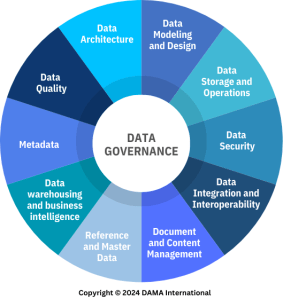
Very often Data Governance is confused with Data management and therefore tools which support Data management are prescribed for Data governance. However, Data Governance is the discipline which ensures that Data management occurs and provides oversight across Data management subject areas shown in the DAMA wheel below. Data Governance requires that Data management is established in the organisation and enforces business agreed rules over these Data management areas.
Some Data management activities already exist in most organisation such as data storage or data warehousing which stores the business data in a chosen software managed by IT, Finance monthly reconciliation. It is due to such examples that it is acknowledged that some form of data governance already exists in organisations however, it is not formalised nor standardised and it is often in silos, only serving the siloed requirements and not enterprise wide benefits. IT will load the data provided to it but it does not have control over how the data is entered into the data entry applications. This inherently leads to duplication of non standardised efforts across the organisation which prevents the organisation from realising the true value of its data.
Whilst the various data management areas often have specialist tools which can help automate the processes, the delivery of data governance is not reliant on such tools or tools which do not already exist within the business. Policies can be produced using a “word” application, Graphics and presentations can be presented using a Power point or in house Business Intelligence application. These are generally available tools in most organisations. A data governance initiative should therefore not be tied to the adoption or acquisition of a tool. It is important to have clear separation of Data Governance and Data Management responsibilities.
Data management areas which require oversight and application of policies include;
- data discovery,
- data profiling,
- metadata,
- data quality,
- data storage
- data modelling,
- data architecture
- data security
- data integration
- reference and master data
- document management
These are fully captured in the DAMA wheel shown to the left having Data governance at its core.
When assessing most organisations using the Data Maturity Model Assessment in DAMA, most organisations fall into Level 1 where there is organisation of data but there is no data owner.
Many organisations operate at a Level 1 data governance capability “Level 1 : The process is characterized as ad hoc, and occasionally even chaotic. Few processes are defined, and success depends on individual effort and heroics.” – Adapted from The Capability Maturity Model. Paulk,Weber and Chrissis
Organisations generally comprise of multiple departments such as HR, Finance, Sales, Marketing, Operations etc where a new team member for one department may, in order to fulfil the requirements of their role description, set up a data storage folder which helps them to facilitate their regular activities. This is a form of data governance although, this practice is limited either to one individual or their team and the benefit of such practice is not shared across the organisation. In addition, such data is obtained and used without adequate oversight on its quality, storage and security requirements or it’s reliability because there is an inherent assumption that the data is right.
If only one department kept their data organised, governed and managed to the best of their ability, any benefit that would be useful across the departments, is missed. Equally, when the knowledge holder in the governed team leaves the organisation, this knowledge goes with them
Data Governance cuts across the complete data lifecycle from data entry processes, storage and eventual deletion.
How do we achieve no tool, low tool data governance then?
Many organisations seek tools to help stand up a data governance capability without understanding their business model and the various data management functions. “By definition, a tool exists to improve something you are already doing. If you are not doing formal DG yet, or if you are doing it poorly, then casting about for a tool to help you deploy DG is a waste of time“. – John Ladley (2020) – Data Governance 2nd Edition
In order to achieve data governance, the first step is to understand the business model, data landscape and the applicable legal framework
As Data Governance is a practice which is expected to become part and parcel of the organisation and embedded in it, it is not necessary to obtain a specialist tool for this purpose
If following the Non-Invasive Data Governance approach as described by Robert S. Seiner in his book, he provides Common Data, Activity and Communication matrix templates which can be used as tools to monitor your data governance processes. These matrixes can be built into Excel spreadsheets
Depending on the data governance approach taken, data governance initiatives do not requires venturing into new tools and software to be initiated. There are innovative vendor tools which provide capabilities across the data management subject areas and therefore consolidate outcomes which allows easy viewing of the data governance objectives at scale.


Leave a comment